

In this article, we discussed how a blog can help your business grow. But, what are the things to do once you start getting some traffic to your website? How do you create the right strategy to convert your readers into potential leads. Now, this all starts when you research for the keywords to write. The reader on your blog must be somehow related to your business. If your articles are optimized in that way, you can start utilizing some methods to convert your readers into leads or your buyers.
For this article, I have made a list of points which are easy to follow. There will be some examples which you can understand and apply in any type of business.
CTAs (Call to Actions) are really important and it is really important to optimize your posts with the right CTA at the right point for maximum conversions.
Turning your blog readers into potential customers is a combination of different things including the design of your website, brand positioning, and a right approach. You may have to do some changes to your blog content if required. Optimizing the CTAs is the major step here. So, without any further delay’s let get started.
What is CTA?
CTA stands for Call to Action. It’s any prompt that tells your reader exactly what to do next. In marketing terms, a CTA is the bridge between content consumption and conversion.

Without it, people just read your blog and leave. With a proper CTA, we make our readers come a little closer to the product or service we want to sell to them.
Some examples of a good CTA are:
Examples of a CTA:
- “Download our free SEO checklist”
- “Join 5,000+ marketers getting weekly growth tips”
- “Book Demo Today”
If the goal is just to collect leads, readers are offered something free in exchange of their emails or phone numbers. However, CTAs can directly be about your core product or business. So, if you are trying to catch some audience through a blog, this guide is going to help you.
Understanding the goal of your blog
Blogs can be used to target any level of your business funnel. Most people utilize it as TOFU (Top of the Funnel) strategy. But, this all comes down to it’s purpose. So, it is important to understand the purpose of your blog instead of its positioning. Some of the goals of a blog could be:
- Build an email list
- Generate demo or consultation requests
- Push readers toward product trials or purchases
So, if you want your audience to call you, your blog and its articles must have “Call Us” or “Message Us” CTAs.
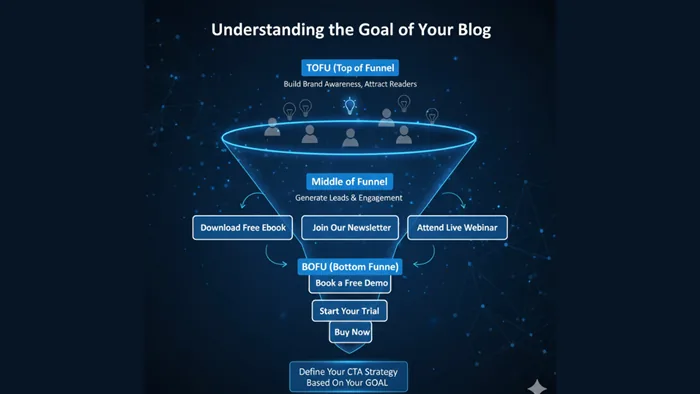
For example, you want to promote a business software. In this case, you should optimize your articles to allow users to easily download the product. This includes adding links that are easily accessible through buttons and one-click downloads.
CTAs That Match Reader Intent
Top of the Funnel readers are generally curious people or who are just learning about something. The best CTA type for those people are Free guides, checklists, comparisons, etc.
For Middle of the Funnel readers, the evaluation type content works the best. Some examples are case studies and webinars.
For the Bottom of the Funnel, which is the most important for businesses, the mindset is always about the Act. So, the best CTAs are Free Consultion and Book Demo.
For example, if your If your post is “5 Ways to Speed Up a WordPress Website,” the right CTA can’t be “Book a Call.” The best CTA will be “Download our Free WordPress Speed Optimization Checklist.
Find Attention points and place CTAs carefully
Sidebar banners were really popular in the earlier days for CTAs. They are still used but we are going to use some different places where users pay their attention more. Here are some of the locations you can use.
- Inline CTAs – Embed subtle CTAs inside the post after delivering value. Example: after step 2 of a tutorial, add “Did this work for you? Here’s our WordPress development service.”
- End-of-post CTAs – This is really important. After someone reads the whole article, they’re primed for a soft conversion. So, it is good to add banners and buttons at the end of your article.
- Exit-intent popups – Capture people who are about to leave. Offer a guide or discount, and do not do spam or forced selling.
- Header or floating CTAs – Great for persistent awareness (like newsletter or trial buttons). Keep it non-intrusive.
In the GAA or tools like Hotjar, there is a feature called scroll-depth tracking. It helps you understand where your users drop-off. It is good to insert your CTA before that point.
Make your CTA sound natural and human
Instead of using “Subscribe to our Newsletter”, you can try adding “Join 3,000+ marketers who fixed their site’s SEO in 2025.”
Examples:
- Benefit + Action: Get faster load times- Download our free WordPress checklist
- Social Proof + Outcome: “Join 1000+ Developers who have found their clients”
- Urgency + Results: “Last Change to Access our Free eBook”
Do not forget A/B testing
Testing is the best way to optimize your articles for the best results. You should test different variations for: est variations:
- Offer type (ebook vs free audit)
- Button text (“Get Guide” vs “Download Now”)
- Button color or size
- CTA placement (inline vs end of post)
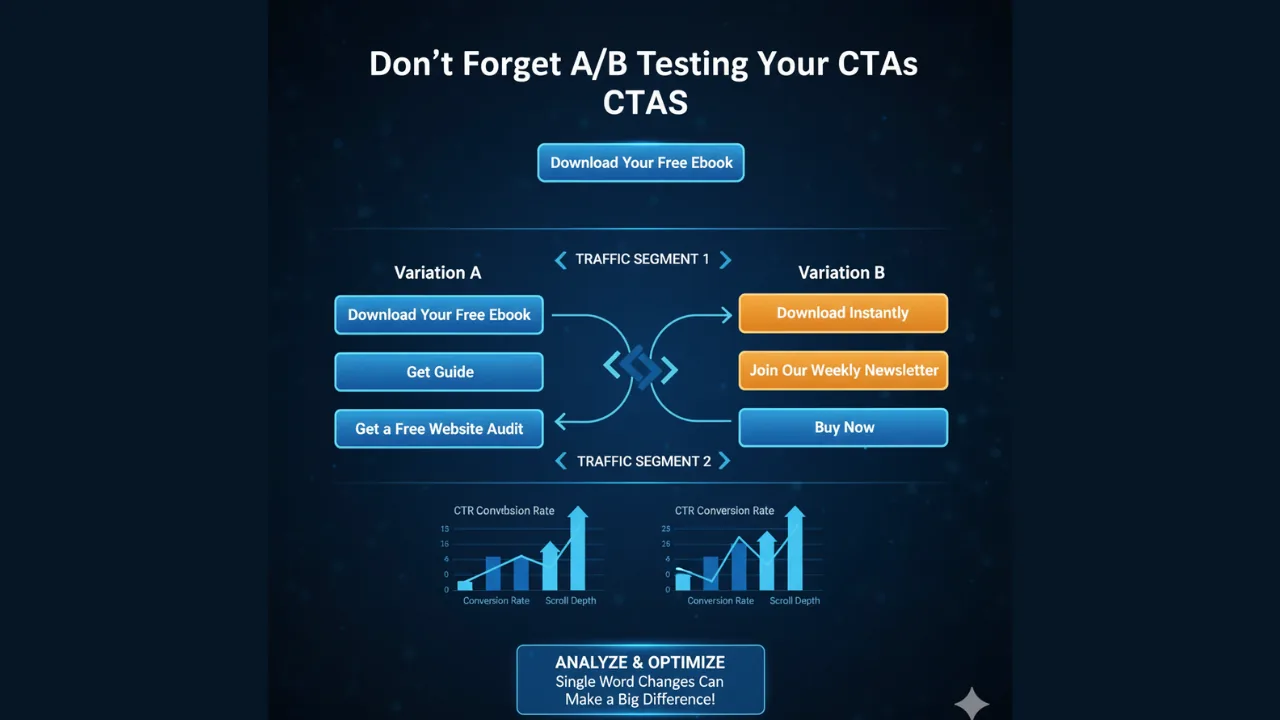
Make sure to always track for the changes in CTR, conversion rates, and scroll depth. Sometimes, a change of single word can make a big difference in your conversions.
Conclusion
Converting your blog readers into your buyers or just getting leads out of them can be a little complex when you don’t know the right things. Now, there are different CTAs which can be applied in different scenarios. So, it is good to experiment and find new ways to drive your traffic to the pages, products, or services you want to sell.